September 17, 1787
Preamble frames federal power and constitutional purposes


Gouverneur Morris drafted the Preamble's six purposes for the new government
📜Constitutional Law📚Historical Precedent
September 17, 1787
Gouverneur Morris drafted the Preamble's six purposes for the new government
The Preamble lists six explicit purposes: form a more perfect Union, establish Justice, insure domestic Tranquility, provide for the common defence, promote the general Welfare, and secure the Blessings of Liberty. These goals guide interpretation of the Constitution's operative clauses.
Gouverneur Morris led the Committee of Style and drafted the Preamble's final wording. He changed 'We the People of the States' to 'We the People of the United States,' advancing his nationalist vision for a stronger federal government.
Convention delegates signed the final Constitution on September 17, 1787, at Independence Hall in Philadelphia. New Hampshire became the ninth state to ratify on June 21, 1788, making the document effective among the states.
The Supreme Court has made clear for over a century that the Preamble doesn't confer enforceable powers or private rights. Real power must come from the Constitution's operative clauses. Courts may cite the Preamble when interpreting ambiguous provisions, but no court has used it as a decisive factor.
In Chisholm v. Georgia (1793), Justice James Wilson and Chief Justice John Jay relied on the Preamble to support jurisdiction over Georgia. Jay cited 'We the People' and 'establish Justice' to conclude federal courts could hear cases between states and citizens of other states.
Morris was a nationalist champion of powerful federal government. In 1802, Senator Morris argued the Preamble barred Jefferson's attempt to eliminate federal appeals courts. Federalists argued the Preamble combined with the Necessary and Proper Clause made the Bank of the United States constitutional.
The phrase 'promote the general Welfare' in the Preamble doesn't by itself authorize unlimited federal spending
The Supreme Court in Helvering v
Davis (1937) affirmed Congress's spending discretion but ruled the Preamble alone isn't a grant of power Legal scholars treat spending power as constrained by text and precedent.
Why do 15 states impose photo ID rules despite lower Latino turnout?
How did Congress spend $22.7 billion on 8,222 earmarks amid 35.9 million people in poverty?
Can the federal government force states to adopt policies by threatening to cut all their funding?
The Preamble promises to 'secure the Blessings of Liberty'—why did Black unemployment hit 10.3% in DC while white unemployment was 3.4% in Q2 2025?
The Preamble promises to 'secure the Blessings of Liberty'—why did Shelby County v. Holder gut the Voting Rights Act in 2013, opening the door to voter suppression?
Upgrade to Premium to access all practice questions and unlock advanced quiz features.
Upgrade to PremiumThese questions are part of the Preamble frames federal power and constitutional purposes topic. Master this topic by completing the quiz or exploring each question in detail.
Take the full quiz to master this topic and track your progress.
Start QuizPennsylvania delegate and Committee of Style chairman
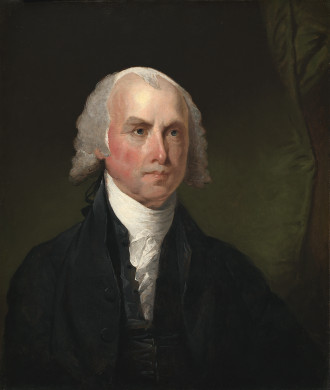
Virginia delegate and primary Constitution architect
Pennsylvania delegate and early Supreme Court Justice
First Chief Justice of the United States
research
Read the Preamble in context with Article I powers
The Preamble's goals only gain legal force through the Constitution's operative clauses. Understanding how the Spending Clause, Commerce Clause, and Necessary and Proper Clause interact with Preamble purposes shows how Congress justifies major programs.
research
Track how legislators invoke the Preamble
When Congress debates spending bills, members often cite 'promote the general Welfare' to justify programs. Watch floor debates on C-SPAN to see how the Preamble frames policy arguments.
civic action
Visit the National Archives to see the original document
The original Constitution with the Preamble is on display at the National Archives in Washington, D.C. Seeing the document Morris drafted connects you to the physical history of American democracy.